Choosing a 240-volt inverter generator involves balancing power output, fuel flexibility, noise levels, and safety features. The models below are dual-fuel or inverter generators that support 240V operation, making them suitable for RVs, home backup, and electric vehicle charging scenarios. This guide highlights five top options with robust safety sensors, electric start, and compact, travel-friendly designs. Use the buying guide to compare runtimes, THD levels, and RV compatibility so you pick the right fit for your needs.
Summary of selected products:
| Product | Brand | Voltage | Fuel Type | |
|---|---|---|---|---|
| WEN Quiet 6800-Watt DF680iX | WEN | 240V | Dual Fuel | CO Watchdog, EV charging capable, electric start |
| Westinghouse 11000 Peak Dual Fuel | Westinghouse | 120/240V | Dual Fuel | Remote start, multiple outlets, CO sensor |
| Gidrox 6000W Dual Fuel Inverter | Gidrox | 120/240V | Dual Fuel | CO sensor, RV adapter included, inverter tech |
| WEN DF475T 4750/240V Dual Fuel | WEN | 120/240V | Dual Fuel | Electric start, 240V capable |
| Gidrox 7500D Dual Fuel Inverter | Gidrox | 120/240V | Dual Fuel | RV adapter included, quiet, CO sensor |
WEN Quiet 6800-Watt DF680iX Inverter Generator

The WEN DF680iX delivers 6800 surge watts and 5100 running watts on gasoline, with 6000 surge and 4500 running watts on propane. It operates in a bonded-neutral 240V configuration suitable for Level 2 EV charging and backup power. A CO shutdown sensor enhances safety by automatically turning off the unit if dangerous carbon monoxide levels are detected. This model also features an electric start for quick deployment and a compact footprint that travels well for outdoor use or road trips. It’s designed for users who need reliable 240V output with dual-fuel flexibility.
Key considerations:
– Pros: Dual-fuel versatility, 240V charging-ready, CO watchdog, key start.
– Cons: Higher power output may increase weight and cost; regular maintenance recommended.
Westinghouse 11000 Peak Dual Fuel Inverter

With 9000 running watts and 11000 peak watts on gasoline, and 8100 running / 10000 peak on propane, this unit maintains compact inverter technology in a robust package. It features remote electric start, multiple transfer-switch-ready outlets, and a rotating LED display that shows fuel level, power output, remaining run time, voltage, and lifetime hours. The low THD (less than 3%) protects electronics and sensitive devices. It supports up to 17 hours on a large fuel tank and offers safe, user-friendly operation for home backup, camping, or job sites requiring 240V supplies.
Key considerations:
– Pros: High wattage, multiple outlets, LED data center readout.
– Cons: Heavier unit; longer runtime is fuel-dependent.
Gidrox 6000W Dual Fuel Inverter
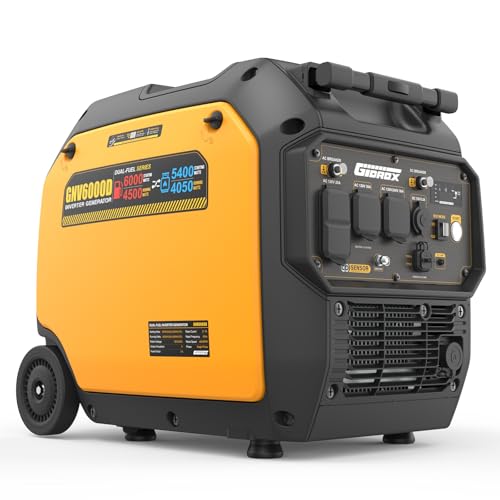
The Gidrox 6000D model provides 6000 starting and 4500 running watts on gasoline, and 5400 starting / 4050 running watts on propane, with a compact 2.9-gallon tank offering up to 12 hours at 25% load. It uses inverter tech to deliver clean power under 3% THD, protecting sensitive electronics. An included dedicated RV adapter (NEMA L5-30P to TT-30R) ensures plug-and-play compatibility for travel trailers and campers. This unit targets RV enthusiasts and mobile users needing reliable, quiet, 240V-capable power.
Key considerations:
– Pros: RV-ready out of the box, quiet operation, dual-fuel flexibility.
– Cons: Moderate runtime at higher loads may require refueling plans.
WEN DF475T Dual Fuel 4,750-Watt

The WEN DF475T provides 4750 surge watts and 3800 running watts on gasoline, with 4350 surge and 3500 running watts on propane, and supports 120V to 240V transition. The electric start makes it easy to deploy, and its 224cc engine powers a compact unit suitable for emergency backup, especially where a 240V path is needed for specific loads. Its dual-fuel capability adds flexibility for outages or off-grid use, while maintaining a reasonable noise profile for backyard use.
Key considerations:
– Pros: 240V adaptability, simple controls, electric start.
– Cons: Lower wattage than larger models, may not cover very heavy loads alone.
Gidrox 7500W Dual Fuel Inverter

The Gidrox 7500D delivers 7500 starting / 6000 running watts on gasoline and 6750 starting / 5400 running watts on propane. It includes a 3.6-gallon fuel tank delivering up to 12 hours at 25% load, and comes with an RV adapter for easy hook-up. Inverter technology maintains clean power with under 3% THD, protecting sensitive electronics. Aimed at RVs, camping, and mobile workplaces, this unit combines high output with portable design.
Key considerations:
– Pros: High 240V payload, RV-ready, quiet operation.
– Cons: Higher fuel consumption at peak outputs, weight considerations.
Buying Guide: 240V Inverter Generator Essentials
When shopping for a 240V inverter generator, consider these factors to ensure you meet your power needs and footprint constraints:
- Power output and suitability: Match surge and running watts to your critical loads. For RV charging and home backup, aim for models in the 4500–9000 running watts range on gasoline with 240V capability if you anticipate big loads.
- Fuel flexibility: Dual-fuel units offer reliability during outages. Propane can be stored longer, while gasoline provides higher energy density for longer sessions.
- Inverter quality and THD: Low total harmonic distortion (under 3%) protects electronics and modern devices, especially delicate electronics and EV charging equipment.
- Safety features: CO sensors, automatic shutoffs, and robust containment for exhaust are important for indoor or semi-enclosed spaces and quiet neighborhoods.
- Starting method: Electric start offers quick deployment; recoil or push-button options provide flexibility in remote locations.
- RV and transfer switch readiness: If you plan to power a home or RV with a transfer switch, ensure the unit includes a suitable 120/240V output and RV-ready adapters are included or readily available.
- Runtime and tank size: Larger tanks extend operation time between refuels. Consider your typical session length and fuel availability.
- Noise level: Inverter generators typically run quieter than traditional open-frame models; check decibel specifications if you use the unit near living spaces or campsites.
Finally, compare warranty terms, after-sales support, and availability of replacement parts. For users prioritizing 240V charging for EVs, verify compatibility with Level 2 charging requirements and ensure the unit can sustain continuous operation without overheating.