Choosing the right adhesive can dramatically improve bed adhesion, reduce warping, and simplify print removal. The following selections include glue sticks, sprays, and liquid solutions designed for common build surfaces like glass, PEI, and BuildTak. Each option demonstrates strong initial grip, safe formulation, and easy cleanup to support reliable, high-quality 3D prints across PLA, ABS, PETG, and other materials.
style=”margin-top:0;”>
| Product | Brand | Build Surface Focus | Format | Key Benefit |
|---|---|---|---|---|
| Creality Glue Sticks | Creality | Hot bed | PVP Solid | Reliable, safe, easy coating |
| 3DLAC Adhesive Spray | 3DLAC | Glass, PEI, BuildTak, Kapton | Aerosol Spray | Firm adhesion with quick release |
| 3D Printer Adhesive Glue Bed Weld | LAYERNEER | Various surface coatings | Liquid/Coating | Long-lasting, affordable per print |
| Magigoo All-in-One | Magigoo | Glass, PEI, BuildTak, Kapton | Liquid Glue (50mL) | Works across multiple filaments |
| ENOMAKER Bamboo Lab Bed Adhesive | ENOMAKER | Various build plates | Liquid | Strong adhesion, low residue |
Creality 3D Printer Glue Sticks for Hot Bed

Brand: Creality. This solid PVP adhesive is designed to reduce bed warping by providing a controlled thin coating on hot beds. It emphasizes safe, eco-friendly composition without formaldehyde, making it a practical option for PLA, ABS, PETG, PC, PA, and TPU. The formula supports precise prints with improved adhesion at high temperatures and easy demolding after cooling. Application is straightforward, allowing quick reapplication for multiple prints with minimal waste.
- Quality Assurance: Creality-produced with consistent performance
- Eco-friendly: PVP-based, formaldehyde-free
- Premium adhesion: Smooth application for thin coatings, reliable debonding
3DLAC 3D Printing Adhesive Spray

Brand: 3DLAC. This spray delivers firm adhesion to common print bed surfaces while enabling quick release when cooling. It’s a convenient alternative to Kapton or blue tape, compatible with PLA, ABS, PETG, HIPS, Carbon Fiber, TPU, and more. The aerosol format allows even coverage for consistent first layers and reduced warping across various builds.
- Firm adhesion with easy release
- Compatible with glass, PEI, BuildTak, Kapton, and other beds
- Supports multiple filaments for flexible workflow
3D Printer Adhesive Glue Bed Weld Original
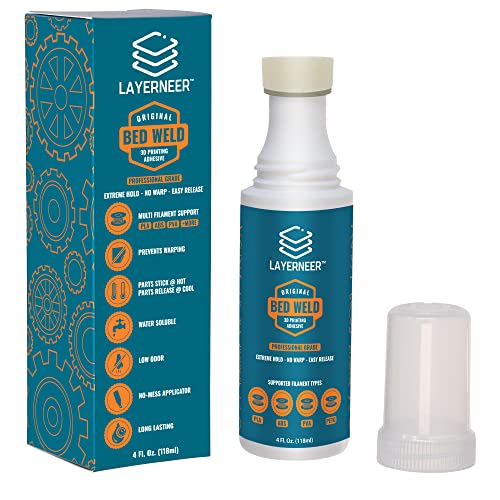
Brand: LAYERNEER. This thermal dynamic coating bonds at hot temperatures and releases as it cools, enabling repeated use and cost-efficient printing. The coating is designed to be long-lasting, with the option to recharge using a wet sponge. It emphasizes low odor and water solubility, making cleanup straightforward and safe for regular hobbyist or professional use.
- Thermal dynamic coating for hot beds
- Long-lasting with reusability
- Low odor and water-soluble for easy cleanup
Magigoo All-in-One 3D Printer Adhesive

Brand: Magigoo. This universal glue is designed to secure ABS, PLA, PETG, HIPS, and TPU on glass, PEI, BuildTak, Kapton, and other surfaces. It bonds reliably, provides a clean release after cooling, and is described as easy to apply by shaking, pressing, and coating the active area. The bond remains stable throughout the print and cleans up with water.
- Works on multiple filaments and surfaces
- Easy application and water cleanup
- Reliable bond with simple release
ENOMAKER Bamboo Lab Bed Adhesive

Brand: ENOMAKER. This liquid adhesive is designed to minimize residue and maximize adhesion across ABS, PLA, PETG, and TPU on various build plates. It emphasizes stronger initial grip, durability for repeated prints, and easier release after cooling. The product notes suggest applying a small amount for long-lasting adhesion with minimal cleanup.
- Strong adhesion across multiple surfaces
- Durable and residue-minimizing
- Easy to reapply for multiple prints
Buying Guide: Key Purchase Considerations
The best 3D printer adhesive depends on your printer model, bed surface, and filament choices. Here are practical considerations to guide your selection:
- Bed surface compatibility: Check whether the adhesive is formulated for glass, PEI, BuildTak, Kapton, or other beds. Some products are universal, while others perform best on specific surfaces.
- Filament spectrum: If you print with PLA, ABS, PETG, TPU, Nylon, or composites, verify that the adhesive performs well with those materials across hot and cool cycles.
- Application method: Solid sticks, liquids, and sprays offer different coverage patterns. Sticks provide controlled coatings; liquids require careful spreading; sprays allow quick, even coverage—especially for large beds.
- Odor and safety: Look for low-odor, water-soluble formulas to minimize headaches and cleanup time. Non-toxic formulations reduce user exposure during frequent use.
- Reusability and cost per print: Some coatings last many prints before reapplication; others require daily use. Consider the per-print cost and whether reapplication is practical for your workflow.
- Removability and residue: A good adhesive should release cleanly as the print cools and leave minimal residue, easing post-processing and surface maintenance.
- Environmental and health considerations: Eco-friendly compositions reduce exposure to harsh chemicals and support safer home or classroom environments.
Comparative Perspectives
For hobbyists, a straightforward glue stick or a simple spray may suffice when printing on glass or PEI with PLA. Professionals or makerspaces may benefit from larger, reusable coatings that withstand high-temperature prints or frequent use across various materials. Some users prioritize residue-free cleanup and water solubility, especially in shared environments. Others value multi-filament compatibility and surface versatility to minimize inventory. The best option often combines strong first-layer adhesion with reliable release after cooling, while fitting your preferred build plate and maintenance routine.