Choosing the right abrasive for aluminum ensures fast material removal, clean etching, and a smooth, ready-to-coat surface. The following five products are well-suited for aluminum prep in both professional shops and DIY spaces. They span long-lasting blast media, durable cloth rolls, and versatile sanding discs to meet different workflows—wet or dry sanding, cabinet blasting, and general surface prep.
| Product | Type | Grit / Size | Best For |
|---|---|---|---|
| TITGGI #80 Grit Aluminum Oxide Blast Media | Blast Media | #80 | Heavy rust removal, fast material removal |
| INTERACTIVIA #60 Aluminum Oxide | Blast Media | #60 | Medium blasting for cabinet use |
| striplus #120 Grit Aluminum Oxide | Blast Media | #120 | Fine finishing and rust/paint removal |
| VSM 10-Pack Maroon Very Fine Non-Woven Pad | Non-woven Pad | Very Fine | Finishing, cleaning, and polishing |
| SACKORANGE 6 LBS Aluminum Oxide (100 Grit) | Blast Media | 100 Grit | Budget-friendly, medium finishing |
TITGGI #80 Grit Aluminum Oxide Blast Media
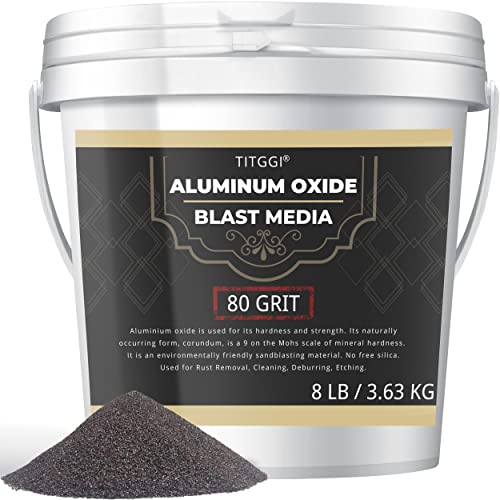
High-hardness brown fused aluminum oxide is rated 9 on the Mohs scale, approaching diamond-like capability for abrasive efficiency. This media performs well on aluminum, steel, and even glass or stone when rust removal or etching is needed. The media is designed for long life and repeated cycles, offering superior durability compared with silica-based options. It is marketed as eco-friendly, with no free silica and full recyclability. While it lasts longer than many alternatives, users should optimize blast parameters to avoid excessive surface roughness on delicate aluminum parts. Wet or dry blasting compatibility adds flexibility for different production environments.
Key features include: hardness to drive rapid material removal, long cycle life, and an emphasis on environmental considerations. This makes it a strong choice for aggressive initial cleaning and rough shaping before finishing steps.
INTERACTIVIA #60 Aluminum Oxide

This 8-lb bag targets medium blasting needs and is designed for blasting cabinets or gun-based blasting. Aluminum oxide offers a good balance between aggressiveness and longevity, especially for aluminum surfaces that require etching for better coating adhesion. The grit is described as sharp angular, which facilitates fast rust and paint removal while reducing smear and smear-related smoothing. It is non-reactive with coatings, which helps preserve coating integrity during prep. Users should monitor dust and ensure proper PPE and mask filtration for better working conditions.
striplus 120 Grit Aluminum Oxide

This 4-pound package features 99.5% purity aluminum oxide with fine grit suitable for precise finishing in sandblasting cabinets or machines. The sharp angular grains cut rust, paint, and scale efficiently while yielding a satin finish on metal, glass, stone, and plastic. The medium is reusable, capable of 6–8 cycles, which lowers per-job costs. Ideal for projects where a consistent satin finish is desired prior to coating, plating, or welding prep. Expect good surface uniformity with controlled resurfacing across complex geometries.
VSM 10-Pack: Maroon Very Fine Hand Pad

These non-woven hand pads provide a finishing option that complements blast-media prep. The maroon color indicates a very fine grade, suitable for final smoothing and surface preps prior to painting or coating. The durable non-woven fabric resists rust and maintains integrity under wet or dry use. Pads can be cut to size for hard-to-reach areas, reducing the risk of gouging or uneven finishes on aluminum components. They pair well with aqueous cleaning steps for a uniform surface texture.
SACKORANGE 6 LBS Aluminum Oxide (100 Grit)

This 6-pound bundle uses virgin brown aluminum oxide with 100 grit for a mid-range blend of aggressiveness and fineness. Suitable for blasting cabinets or guns where a balanced approach is desired—enough removal power to clean rust and coatings while avoiding excessive surface roughness. The packaging approach—multiple bags within a sealed system—helps protect the material from moisture and maintains consistency across jobs. This option provides a budget-friendly entry point without compromising essential performance.
Buying Guide: Key Considerations For Aluminum Abrasives
When selecting abrasives for aluminum, consider surface goals, equipment type, and environmental factors. The following perspectives cover common scenarios to help guide a decision.
- Material Removal vs. Surface Finishing: For heavy rust or paint removal, coarser grits or blast media (like #60–#80) deliver rapid material removal. For finishing or preparing coatings, finer grits (#100–#120) or non-woven pads provide smoother results and better coating adhesion.
- Blasting Method: Cabinet blasting and gun blasting have different dust and media-control requirements. Media with longer life suits repeated cycles in cabinet setups; finer media suits detailed work in smaller cavities.
- Equipment Compatibility: Ensure media hardness and particle shape align with the blasting system. Angular, sharp grains remove faster but can roughen surfaces if not controlled; uniform grains help with consistent finishes.
- Coatings Compatibility: Aluminum oxide is widely used because it avoids attack on aluminum while providing effective cleaning. Non-reactive media helps preserve coatings applied after blasting, especially during pretreatment steps.
- Safety and Environment: Look for media labeled as low-dust or eco-friendly, and wear appropriate PPE. Reusability reduces waste and overall costs, particularly in high-volume settings.
Comparison At A Glance
Across the five highlighted products, users should weigh grit size, price efficiency, and reusability. Coarser media excels in rough cleaning, while mid to fine grits are suited for finishing and coating prep. Non-woven pads provide a complementary option for final smoothing, especially in tight spaces. Consider combining media types within a single project to optimize time and surface quality.
Operational Tips
- Test on a small aluminum sample to gauge finish before processing larger parts.
- Control blast pressure and distance to prevent over-abrading soft aluminum alloys.
- For wet blasting, ensure proper filtration and moisture control to prevent corrosion or etching irregularities.
- After blasting, clean surfaces to remove abrasive residues that could affect coating adhesion.
- Store media in sealed, moisture-free packaging to maintain hardness and effectiveness.