Resawing wood requires a band saw that can handle thick stock with clean, straight cuts. The following selections cover benchtop models, portable options, and compatible blades designed for resawing tasks. Each entry highlights cutting capacity, motor power, and user-friendly features to help you compare performance and value for American workshops.
| Product | Brand | Type | Key Feature For Resawing |
|---|---|---|---|
| WEN 9-Inch Band Saw (BA3959) | WEN | Benchtop | 2.8-amp motor; 3-1/2″ depth; 9″ width; flexible blade sizing |
| DEWALT 20V MAX Band Saw (DCS374B) | DEWALT | Bare Tool | 5″ cutting capacity; LED lighting; portable, deep cuts |
| WEN Band Saw With Stand (BA3962) | WEN | Standalone with Stand | Two-speed operation; large cast table; flexible blade range |
| VEVOR Portable Band Saw | VEVOR | Portable | 110V, 10A motor; adjustable blade guard; large cutting capacity |
| Timber Wolf Bandsaw Blades (Resaw Blades) | Timber Wolf | Blades | High-grade steel; varied tooth configurations for resawing |
WEN 9-Inch Band Saw, BA3959

The WEN BA3959 benchtop band saw delivers a compact option for resawing thin-to-medium boards. Its 2.8-amp motor spins blades up to 2,500 feet per minute, enabling precise cuts through softwoods and hardwoods with moderate thickness. Notable for a budget-friendly entry, it supports blades ranging from 1/8 to 3/8 inches wide, making setup straightforward for hobbyists and small shops.
DEWALT 20V MAX Band Saw (DCS374B)

DEWALT’s 20V MAX band saw offers cordless versatility with a 5″ cutting capacity and integrated LED for working in dim spaces. The compact bare tool is suited for precise resaws on smaller stock or cut-offs where mobility matters. The LED light enhances accuracy on darker work surfaces, aiding straight, safe resawing in field or shop environments.
WEN Band Saw With Stand (BA3962)
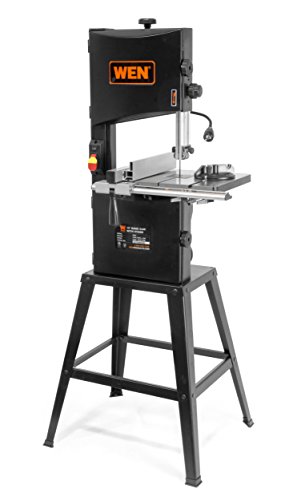
This WEN standalone model adds a sturdy stand and a spacious work surface, making it a balanced choice for resaw tasks. With two-speed operation and a broad range of blade sizes (1/8″ to 1/2″), it accommodates varying stock thicknesses and provides consistent results for thicker resawn boards when paired with appropriate blades.
VEVOR Portable Band Saw

The VEVOR portable model combines a robust 110V, 10-amp motor with a large cutting capacity in a handheld, non-brand-specific form factor. It’s designed for quick, on-site resaw tasks or shop floor work where mobility matters. The ergonomic handle and adjustable blade guard help maintain control during longer resaw runs, with a focus on stable, burr-free cuts.
Timber Wolf Bandsaw Blades (Resaw Blades)

Timber Wolf resaw blades are designed for hardwood and softwood resawing with high-precision teeth and heat-treated carbon steel. These blades offer varied tooth configurations to optimize stability, reduce drift, and maintain blade life during long resaw sessions. They are compatible with many 14″ and larger bandsaws, making them a versatile upgrade for dedicated resaw work.
Buying Guide: Key Considerations For Choosing A Resaw Band Saw
- Cutting capacity: Assess both the depth (how thick the stock can be) and width (for wider boards) to ensure the saw suits your typical projects.
- Motor power and speed: Higher amperage and blade speed can improve resaw efficiency, especially with hardwoods. Consider belt-driven versus direct-drive designs for durability.
- Stand and table: A stable stand and a large, flat table reduce material flex and improve accuracy. Beams and tilting tables aid bevel cuts for curved resawing or pattern work.
- Blade compatibility: Review maximum blade width and thickness supported by the machine. Wider blades carry more resistance but enable deeper resaws; ensure you have suitable blade stock for your stock type.
- Portability vs. permanence: Benchtop models save space but may be less stable than standalone units. Portable units suit mobile workshops; static models excel in precision-heavy tasks.
- Safety and ergonomics: Features like blade guards, soft-grip handles, LED lighting, and easy blade changes reduce fatigue and risk during long sessions.
- Blades for resawing: A high-quality blade with proper tooth geometry (often 4-6 TPI for hardwoods) improves tear-out resistance and edge quality. Consider blade materials and tempering for longevity.
- Upgrade path: If you anticipate heavier use, plan for options such as upgrading to larger benchtop or floor-standing models, and purchasing specialized resaw blades for consistent results.