Finding an affordable dust collection system that still delivers solid airflow and reliable filtration can boost any shop. This guide highlights budget-friendly options suitable for hobbyists and small shops, focusing on units that balance price with performance. Each pick below includes key specs and practical usage notes to help you compare quickly and choose the best value for your setup.
Summary of selected products:
| Product | Motor / Airflow | Capacity | Port Size | |
|---|---|---|---|---|
| WEN DC3401 | 5.7-amp motor, up to 660 CFM | 12-Gallon bag | 4 inches | Mobile base; wall-mount option |
| WEN DC1300 | 1,300 CFM, 14-amp | 50-Gallon bag | 4 inches | Dual inlets; mobile base |
| WEN DC3474 | 7.4-amp induction motor, 600 CFM | 15-Gallon bag | 4 inches | Wall-mount option |
| DEWALT DXVCS002 | High-efficiency cyclone separator | 6-Gallon tank | 1-7/8″ to 2-1/2″ | Compatible with most vacuums |
| DEWALT DXVCS003 | Cyclone separator, 99.5% efficiency | 10-Gallon tank | 1-7/8″ to 2-1/2″ | Heavy-duty cyclone system |
WEN Woodworking Dust Collector DC3401
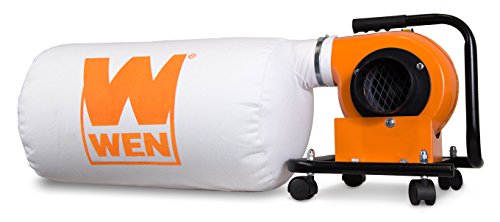
The WEN DC3401 uses a 5.7-amp brushed motor and a 6-inch impeller to move up to 660 CFM. A 4-inch dust port makes it compatible with a wide range of woodworking tools, and its compact design is enhanced by an onboard carrying handle for easy storage and transport. The unit supports an optional wall-mount setup, enabling flexible placement in small shops. This model emphasizes portability and straightforward setup, making it a practical entry point for budget-conscious buyers who still need solid dust control.
WEN DC1300 1,300 CFM Dust Collector

The WEN DC1300 delivers higher airflow with a 1,300 CFM rating and a 14-amp motor, designed for mid-sized workshops. It accommodates up to two tools simultaneously via dual 4-inch inlets and utilizes a vertical 50-gallon collection bag, reducing the frequency of emptying. Despite its greater capacity, the unit remains mobile with a base that supports easy relocation. This model suits buyers who need stronger dust capture without stepping into industrial-class gear.
WEN DC3474 Woodworking Dust Collector

The DC3474 pairs a 7.4-amp induction motor with a 9-inch impeller to move up to 600 CFM. It includes a 4-inch dust port, allowing straightforward connections to typical woodworking tools. A notable option is its wall-mount capability, enabling convenient placement for workshops that prioritize space efficiency. This model is positioned as a balanced choice between power and footprint for smaller shops with variable dust-removal needs.
DEWALT Dust Separator DXVCS002

This DEWALT dust separator focuses on high efficiency by capturing debris before it reaches the vacuum, significantly reducing suction loss and filter clogging. It supports a wide range of materials and uses a four-caster base for mobility. With output options of 1-7/8″ and 2-1/2″ ports, it fits various hose configurations and shop vacs, offering a versatile upgrade for households already using compatible vacuum systems. It’s a practical choice for users seeking to extend filter life and maintain steady airflow.
DEWALT Dust Separator DXVCS003

The DXVCS003 continues DEWALT’s cyclone approach with a 99.5% efficiency rating, designed to capture debris before it enters the shop vacuum. Its 10-gallon tank capacity and robust cyclone separation are built for heavy-duty use, making it well-suited for longer sessions and larger cleanup tasks. The unit supports standard hose sizes and can be mounted or used with a compatible vacuum, helping keep the shop cleaner with less frequent filter maintenance.
Buying Guide: How to Choose a Budget Dust Collector
Key considerations affect performance and value when shopping on a budget. Start with airflow needs, measured in CFM, and match it to your tools and shop size. A unit with 600–1,300 CFM covers most hobbyist setups, but the number is not the only factor; motor type (induction vs. brushed) influences longevity and noise. Port sizing matters for tool compatibility, with 4-inch ports being standard for woodworking. If space is tight, look for wall-mount options or a compact footprint. A bag capacity (gallon) affects how often you empty, impacting downtime.
Filtration and debris handling reduce maintenance efforts. Some models rely on cyclone separators to reduce clogging, while others emphasize a larger collection bag. For portable workshops, mobility and a stable base matter; for fixed spaces, wall-mount or smaller footprints can maximize usable area. Compatibility with existing vacuums or multi-tool setups can influence your total cost of ownership. Finally, consider noise levels and ease of assembly, as these affect day-to-day use and safety in shared spaces.
In practice, a balanced choice combines airflow, durability, and flexibility at a reasonable price. If you regularly switch between tools, prioritize dual inlets and easy tool retrofits. If you primarily clean up large shavings and dust with a single station, a cyclone-based separator system can extend filter life and maintain suction. For hobbyists focusing on value, models with a wall-mount option and straightforward maintenance provide the best long-term return.