Choosing the right diamond blade for an angle grinder can dramatically improve cutting precision, speed, and safety. This guide highlights five high-performing blades that balance durability, versatility, and clean results across masonry, tile, stone, and concrete projects. Each option below is designed to minimize chipping, reduce vibration, and extend blade life in both wet and dry applications.
Summary of chosen products
- EZARC Stone Master 4-1/2″ Segmented Diamond Blade — aggressive cutting for masonry and stone.
- DEWALT Diamond Blade for Masonry — durable, long life with thinner kerf for faster cuts.
- EZARC Super Thin 4-1/2″ Diamond Blade — precise tile cuts with reduced chipping.
- Makita E-07222 X-Lock 4-1/2″ Turbo Rim Diamond Blade — long life and quick blade changes.
- INWELL 4-1/2″ Segmented Diamond Saw Blades — fast cutting with effective debris removal.
EZARC Stone Master Diamond Blade For Angle Grinder

EZARC’s 4-1/2 inch segmented diamond blade is designed for aggressive cutting of masonry materials such as granite, concrete, sandstone, and limestone. The blade’s segmented design increases cooling and debris removal, helping to maintain cutting performance under extended use. It is suitable for professional use as well as DIY projects, where speed and reliability matter. The blade’s construction emphasizes durability, allowing for repeated work cycles with minimal wobble and vibration.
DEWALT Diamond Blade For Masonry

DEWALT’s 4-1/2 inch continuous rim dry-cut diamond blade delivers high performance with a thinner kerf to speed up cutting while reducing dust. The blade is designed for masonry work and is compatible with standard 7/8-inch arbor angle grinders. It emphasizes durability and material removal efficiency, making it a go-to option for long cuts through brick, concrete, and stone. The diamond matrix is engineered to deliver reliable life across multiple projects, with smoother operation and less blade chatter.
EZARC 4-1/2 Inch Super Thin Diamond Blade
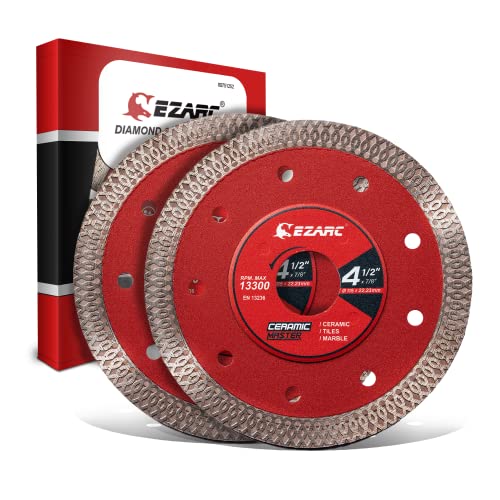
EZARC’s Super Thin Diamond Blade is engineered for precise tile work. Featuring an X-teeth turbo mesh rim, this blade delivers clean, chip-resistant cuts in porcelain and ceramic tiles. Its reduced cutting force minimizes tile breakage, while its versatility supports both dry and wet cutting. The blade is particularly well-suited for installers and DIYers seeking high-precision cuts with minimal post-cut finishing.
Makita E-07222 X-Lock 4-1/2″ Turbo Rim Diamond Blade

Makita’s X-Lock 4-1/2″ turbo rim blade pairs high durability with an easy, fast blade-change system. Designed for masonry cutting, it blends longer life with efficient cutting speeds, aided by a robust bond matrix and taller, stronger diamond segments. The X-Lock system reduces downtime, helping users switch blades quickly on job sites while maintaining cutting efficiency through tough materials like concrete and stone.
4.5″ Diamond Blade For Angle Grinder, Ultra-Thin Tile Blade

ZORUNNA’s 4.5″ ultra-thin tile blade is engineered for porcelain, ceramic, and granite cutting with minimal chipping thanks to X-teeth turbo mesh design. It supports both wet and dry cutting, ensuring versatile performance across tile, stone, and masonry tasks. The blade features a thicker core design to reduce vibrations and enhance safety during operation, making it a practical option for precision tile work and lightweight masonry projects.
Buying Guide: Key Purchase Considerations
- Material compatibility: Choose blades designed for the target material (tile, stone, masonry, concrete). Segmented blades excel in dense or abrasive materials, while continuous rims are preferable for clean tile cuts.
- Cutting conditions: If you’ll work mostly dry, look for blades rated for dry-cutting with dust control features. For porcelain and ceramic tile, a super-thin design with precise edges helps minimize chipping.
- Arbor compatibility: Confirm arbor size and mounting system (7/8″ vs 5/8″ or other). Some blades include adapters or rapid-change systems like Makita’s X-Lock for faster swaps.
- Durability and heat management: Blades with efficient cooling channels and larger bond matrices reduce overheating and extend blade life on tough materials.
- Precision vs. speed: Thinner kerfs cut faster and with less material waste but may wear quicker under heavy use. Segmented blades offer faster removal on masonry, while continuous rims deliver smoother tile cuts.
- Maintenance and safety: Look for vibration-reduction features and robust steel bodies to minimize wear and improve operator safety during heavy-duty tasks.
- Brand ecosystem and warranty: Reputable brands often provide longer warranties and compatibility with a range of grinders. For professionals, a two-pack or multi-pack offers value for ongoing projects.
When selecting a diamond blade for an angle grinder, balance cutting material, blade design, and work conditions. For tile and porcelain, consider a super-thin or tile-specific blade to minimize chipping. For masonry and concrete, segmented blades with effective cooling yield faster cuts and longer blade life. Always follow manufacturer safety guidance, wear protective gear, and use appropriate cooling when required to maximize performance and safety on the job.