Choosing the right drum sander is essential for achieving smooth, flat surfaces on panels, doors, and cabinet components. This guide highlights top picks that balance power, belt speed, dust control, and user-friendly adjustments. Each option is designed to maintain consistent results across wide boards and long runs, helping woodworkers reduce finish time and maximize yield. Below, you’ll find five drum sanders selected for performance, reliability, and value.
To help you compare quickly, here is a summary of the chosen products. The table lists the model, brand, and a quick note on each sander’s standout feature:
| Product | Brand | Key Feature |
|---|---|---|
| JET 16-Inch Drum Sander with Open Stand (JWDS-1632) | Jet | Sandsmart control with adjustable bed parallelism |
| JET 10-Inch Benchtop Drum Sander (JWDS-1020) | Jet | Infinitely-variable speed and quick abrasive changes |
| JET 22-Inch Drum Sander with Open Stand (JWDS-2244) | Jet | Large width with tool-free bed adjustments |
| VEVOR 22″ Drum Sander with Stand (B0FQCXJZM2) | VEVOR | Independent dual motors for consistent sanding |
| JET 25-Inch Drum Sander, Closed Stand (JWDS-2550) | Jet | High-capacity 25″ width with heat-dissipating drum |
JET 16-Inch Drum Sander With Open Stand

This 16-inch model combines substantial sanding width with a 1-1/2 HP motor for robust material removal. Sandsmart control continuously monitors load on the drum motor and adjusts the conveyor speed to maximize feed rate without overloading. The bed’s parallelism can be dial-adjusted from the outside, allowing quick setup for flat boards. The integrated dust hood channels chips and dust efficiently to a 4-inch collection port, helping to keep the work area cleaner and reducing airborne particulates. Suitable for cabinet doors and panels, it delivers consistent finishes across wide stock.
Key considerations: The open stand design provides accessible maintenance and chip collection access. The Sandsmart feature helps manage varying board densities, but users should still implement a dust collection system for optimal air quality. The control layout is intuitive, though larger boards may require careful handling to maintain flatness during long runs.
JET 10-Inch Benchtop Drum Sander
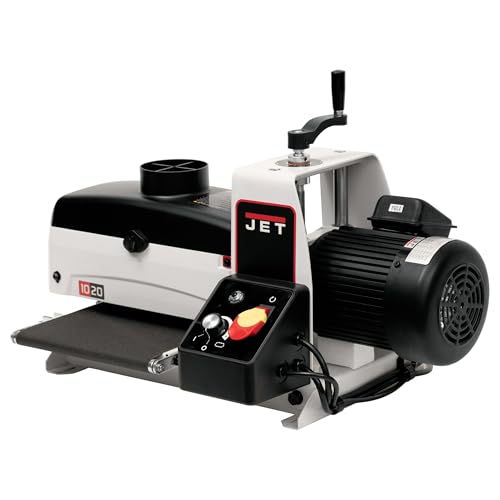
This compact benchtop sander is powered by a 1 HP motor and features a rigid die-cast aluminum and steel body for stable operation. It offers infinitely variable speed control so users can dial in the exact feed rate for different woods and thicknesses. The toolless abrasive take-up fasteners simplify changing belts, saving setup time between projects. While smaller than larger floor models, this unit excels for small parts, edge work, and delicate surfaces where precision and repeatability matter. It’s a practical choice for hobbyists or shops with limited space.
Key considerations: The benchtop format saves floor space, but capacity is limited for wide panels. Variable speed is a strong feature for material versatility. Ensure adequate dust control to protect lungs during extended sanding sessions, especially with dense hardwoods.
JET 22-Inch Drum Sander With Open Stand

With an 22-inch wide capacity, this sander accommodates larger panels and provides robust material removal while maintaining flatness across wide workpieces. Sandsmart control automatically adjusts to load, keeping the drum speed and conveyor feed in balance. The bed parallelism dial allows quick, tool-free returns to a flat reference position, improving repeatability across multiple passes. The open stand design improves accessibility for maintenance and chip disposal, and the 1-3/4 HP motor offers ample power for dense woods and veneer applications.
Key considerations: The wider bed is excellent for panels but requires a stable, level work surface. Tool-free adjustments reduce downtime, but operators should ensure dust collection integration to manage fine particulates and improve finish quality.
VEVOR 22″ Drum Sander With Stand

The VEVOR drum sander offers a dual-motor arrangement with independent drives to optimize sanding consistency across wide boards. A 22-inch belt works well for cabinet doors and large panels, and the model includes extension tables and a dust port for efficient chip removal. The 1.75 HP main motor and 1440 RPM belt speed deliver reliable cutting action across a range of wood species. A stable conveyor belt tracker minimizes drift, contributing to uniform finish quality. Variable speed control lets users tailor feed rates to board density and thickness.
Key considerations: Dual motors can mean higher initial investment but provide better control over sanding aggressiveness and feed stability. Proper alignment and belt tracking maintenance are essential for maintaining surface flatness over time. Dust collection should be paired with a suitable shop system for best results.
JET 25-Inch Drum Sander, Closed Stand

This larger-capacity sander features a closed stand and a 1-3/4 HP, 115V motor for heavy-duty panel finishing. Sandsmart control monitors drum load and adjusts accordingly, ensuring steadier belt speed during long runs. The bed’s parallelism dial is easily accessible on the outside, enabling quick restoration of a flat reference plane. The drum is designed for efficient heat dissipation, helping maintain consistent performance during extended sanding sessions. It’s well-suited for cabinetry, furniture components, and higher-volume shop workflows where wide surfacing is frequent.
Key considerations: The closed stand simplifies cleanup and dust capture, but the footprint is larger. The heat-dissipating design helps maintain performance, though ongoing maintenance of belt tension and bed alignment remains important for long-term accuracy.
Buying Guide: Key Purchase Considerations
- Board width and thickness: Match the machine’s maximum sanding width to your typical stock size. Wider beds save time on large panels but require ample shop space.
- Motor power and belt speed: Higher horsepower and faster belt speeds remove material quickly but may require careful control to avoid ridges. Look for adjustable speed to handle different species and thicknesses.
- Bed parallelism and alignment: Quick, tool-free adjustments help maintain a flat reference surface across passes, improving edge-to-edge consistency.
- Dust collection: A robust dust port or integrated hood reduces airborne dust and helps keep the work area clean. Pair with a suitable shop vacuum or cyclone system for best results.
- Stand design: Open stands provide easy maintenance access, while closed or enclosed stands can help with dust containment and workspace organization.
- Conveyor yield and stability: A stable conveyor bed with reliable tracking minimizes drift and ensures uniform feed rates across long pieces.
- Maintenance needs: Consider belt tracking, drum wear, and accessibility for blade changes. Models with tool-free belt changes reduce downtime between jobs.
- Budget and space: Benchtop models suit small shops or hobbyists; full-size floor models fit high-volume cabinetry or furniture production.
Overall, the best drum sander for woodworking balances aggressive material removal with surface finish quality, consistent feed rates, and easy maintenance. When selecting, assess your typical stock width, desired throughput, and the level of dust control your shop requires. The models highlighted here provide a range of capacities and features to cover hobbyist to professional settings.