Choosing the right cement for PVC work when moisture is present can be a challenge. The following selections are designed to set quickly in wet or variable conditions, while offering strong, reliable bonds for non-pressure and pressure systems alike. Each option below comes from reputable brands and includes a mix of cement and primer combinations to address common wet-install scenarios in home plumbing, pools, and outdoor repairs.
| Product | Brand | Key Benefit | Amazon Link |
|---|---|---|---|
| Christy’s Wet Or Dry Conditions PVC Cement – Medium Body, Aqua Blue | Christy’s | Fast set in wet/dry conditions; works without primer on non-pressure systems up to 6″ and with pressure below 4″ | View |
| Christy’s Handy Pack: Wet Or Dry PVC Cement and Purple Primer | Christy’s | Includes cement and purple primer for versatile, quick bonding in varied conditions | View |
| Christy’s Handy Pack: Red Hot Blue Glue Medium Body PVC Cement and Purple Primer | Christy’s | Rapid cement set time with primer for diverse PVC systems | View |
| Weld-On Pool Heavy 746 Gray | WELD-ON | Specialized for PVC pool/spa installations | View |
| WELD-ON 10250 P-75 Wet/R Dry PVC/CPVC Non-Bodied Primer | IPS | Rapid surface softening for maximum fusion in wet or quick-set applications | View |
Christy’s Wet Or Dry PVC Cement — Fast, Wet-Set Option
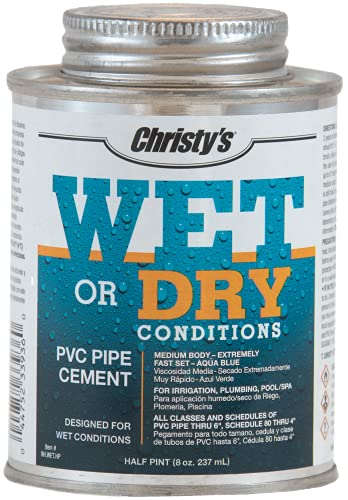
Christy’s Wet Or Dry Conditions PVC Cement is engineered for quick performance in both wet and dry environments, making it ideal for jobs that encounter moisture during assembly. The medium-body formula provides an even flow that helps create reliable seals without extensive hold times. It can cure rapidly in conditions where water exposure is present, helping to keep projects on schedule in kitchens, basements, or outdoor plumbing runs. A notable advantage is its ability to operate without a primer for non-pressure piping up to 6 inches and with pressure systems under 4 inches, expanding its versatility for many residential PVC installations.
The product is designed for a variety of PVC applications beyond joints, including potable water lines, conduits, and DWV drainage paths. When working in wet areas, users typically apply the cement to both pipe and fitting surfaces, insert, and hold briefly to ensure full engagement. Although it sets quickly, curing times can still vary with pipe size and ambient conditions. Always ensure surfaces are clean and dry to the extent possible before application.
Christy’s Handy Pack: Wet Or Dry Cement With Purple Primer

This Handy Pack offers a combined solution for wet or dry conditions, pairing medium-body PVC cement with purple primer. The primer aids in creating a stronger bond by preparing and slightly deglossing the pipe surface, which can be especially helpful on smooth PVC. The cement is designed to work without primer on non-pressure systems up to 6″ and with pressure systems under 4″, but the included purple primer broadens compatibility for tighter or more demanding installations. It’s suited for PVC pipe and fittings used in potable water, drainage, conduit, and sewer projects, as well as non-pressure and some pressure piping under the specified limits.
When using the primer, apply a thin coat to both pipe and fitting, allow a brief set time, then apply the cement. Insert fully and rotate slightly to distribute the adhesive. The result should be a strong, watertight joint once the cement cures. As with all PVC cements, avoid contact with skin and eyes, and work in a well-ventilated area.
Christy’s Handy Pack: Red Hot Blue Glue With Purple Primer
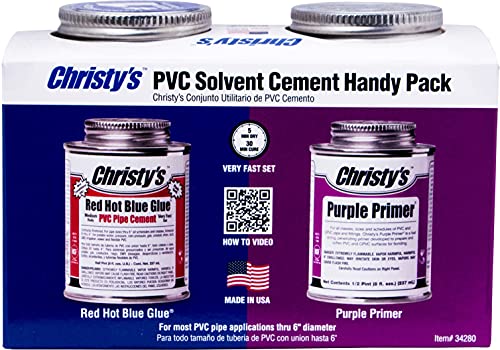
This pack pairs a Red Hot Blue Glue medium-body cement with a purple primer, designed for high-visibility and quick work in busy settings. The Red Hot blend is formulated to achieve rapid drying times, enabling faster progress on PVC joints that require enough handling strength within a short window. The purple primer component helps to prep surfaces for a stronger bond, particularly on smooth or previously exposed piping surfaces, improving fusion with both potable water and drainage systems. Typical usage includes applications up to 6″ pipe size, including Schedule 80, depending on system pressure and configuration.
Operational guidance emphasizes ensuring surfaces are clean and dry before primer application, followed by the cement. The joint should be made promptly after applying cement and primer, with a brief twist to distribute adhesive evenly. Always observe safety guidelines and cure times to guarantee a leak-free seal.
Weld-On Pool Heavy 746 Gray — Pool PVC Glue

Weld-On 746 Pool Heavy is a solvent cement specifically formulated for pool and spa PVC installations. It addresses the broader requirements of large-diameter piping and systems exposed to outdoor elements. The product is designed for strict compatibility with PVC plastics used in pool construction, with cautions about not using solvent types for systems with compressed air or gases. The container’s shelf life and integrity are noted in its labeling, and proper storage helps ensure consistent performance across installations. For wet or variable environments, this cement provides dependable bonding in water feature and pool plumbing projects.
When applying, ensure that joints are clean and dry to the extent possible, then apply evenly to both pipe and fitting surfaces. Insert and rotate to achieve even distribution, and avoid disturbing the joint during the initial set period. Cure times will depend on pipe size and ambient conditions, but expected handling and full cure windows align with standard PVC cement practices.
WELD-ON 10250 P-75 Wet/R Dry PVC/CPVC Primer

The P-75 Wet/R Dry Primer from WELD-ON is designed to soften and dissolve joining surfaces before cementing, which can be crucial for achieving maximum fusion in both wet and quick-set environments. This low-VOC primer is particularly suited for PVC and CPVC pipe and fittings, supporting faster assembly in damp or partially submerged installations. It plays a complementary role when used with solvent cement, helping to prepare the surfaces for a more robust bond. It’s important to follow safety and ventilation guidelines while using primers, as with all solvent-based products.
Buying Guide: Key Purchase Considerations And Comparisons
When choosing a waterproof or wet-environment PVC adhesive, consider the following factors to balance performance, ease of use, and suitability for your project:
- Environment: Wet vs dry conditions, exposure to potable water, and outdoor elements. Choose products designed for wet setting or quick-set needs if moisture is anticipated during assembly.
- System type: Non-pressure versus pressure piping, and pipe size. Some cements perform best on non-pressure lines up to 6″ while others are suitable for smaller pressure systems.
- Primer inclusion: Primers help prep surfaces and improve bonding, especially on smooth or older PVC. Decide if a mixed pack with primer is advantageous for your workflow.
- Compatibility: Verify compatibility with CPVC, Schedule 40/80, and other materials (ABS, rubber, etc.) if repairs involve mixed materials. Some products are specifically formulated for pool and spa applications.
- Drying and cure times: Consider handling times and full cure durations to plan project timelines, especially for critical leak-prone sections.
- VOC content and safety: Low-VOC or high-VOC formulations affect indoor air quality and compliance with local regulations. Follow safety data sheets and use in well-ventilated areas.
- Storage and shelf life: Some solvent-based cements and primers have shelf-life considerations; store tightly closed in a cool, dry place to preserve effectiveness.
- Application tips: Surface cleanliness is essential. For best results, wipe surfaces, roughen smooth fittings if needed, apply primer if recommended, then apply cement to both surfaces and insert fully with a brief twisting motion.
- Code and warranty considerations: Some jurisdictions have specific requirements for pipe joining materials in potable water systems; ensure your choice meets local plumbing codes and manufacturer guidelines.