Choosing a laser level designed for tiling can dramatically improve accuracy and reduce installation time. The following selections are among the best options for achieving level, plumb, and square lines across floors, walls, and ceilings. Each product below is optimized for tiling projects, picture hanging, and related layout tasks, offering clear green beams, multiple 360° lines, and reliable self-leveling features. Compare key specs, then read a focused Buying Guide to help you decide which laser level best fits your tiling workflow.
| Product | Brand | Key Benefit | Highlights |
|---|---|---|---|
| 16 Line Laser Level 360 Self Leveling | MBYULO | Bright, accurate cross lines for room-wide layout | 4×360° coverage, 2 batteries, adjustable brightness |
| Huepar Laser Level LS04CG | Huepar | Four 360° planes with long runtime | Top floor and ceiling lines, 5200 mAh batteries |
| 16 Line Laser Level 360 Self Leveling | ZyQiu | Bright green lines with manual mode option | 2×360° horizontal and 2×360° vertical |
| Huepar 704CG | Huepar | Removable battery and Type-C charging | 4×360° lines, 6600 mAh battery |
| Motovera Laser Level with Tripod | Motovera | Rotary/high-visibility level for outdoor use | IP54, 100 ft range, 4 brightness levels |
Huepar LS04CG Green Beam Laser Level

The Huepar LS04CG provides four 360° laser planes, delivering full room layout coverage for tiling, flooring, and ceiling installations. The device includes two 5200 mAh lithium-ion batteries and a hard carry case, enabling extended work sessions without frequent recharges. The top horizontal line is suitable for ceiling work, while the bottom horizontal line assists tiling on floors. Two vertical lines create a quick 90° reference framework, helping to visualize square layouts across walls and ceilings. A built-in lifting base supports elevation changes, and a 4-level battery indicator helps manage power during projects.
Key features include a robust 5-year warranty and lifetime technical support, reflecting Huepar’s emphasis on service. The tool’s 4D layout supports precise alignment from multiple angles, and its 360° lines facilitate quick room visualization. For tiling, the LS04CG’s top and bottom planes, combined with vertical planes, can simplify substrate preparation and layout marking across large rooms.
Huepar 704CG 4×360 Laser Level

The 704CG pro laser level from Huepar offers four 360° laser lines with two horizontal and two vertical planes, ideal for comprehensive tiling layouts and ceiling work. It ships with a removable 6600 mAh battery and a USB-C charging option, enabling convenient on-site power management. The included magnetic stand and wall plate accessories help achieve quick, stable setups on metal surfaces or drywall alike. The device emphasizes long-term reliability and a strong warranty, making it a practical choice for professional tiling crews and ambitious DIY remodels alike.
Designed to visualize square layouts with 90° intersections, the 704CG helps users project precise lines over floors, walls, and ceilings. The removable battery design supports easy replacement on busy job sites, while the Type-C charging port ensures compatibility with common charging devices. This model is well-suited for tiling floors and kitchens, where consistent line accuracy across 360° planes reduces layout errors and rework.
MBYULO 16-Line Green Laser Level 360

MBYULO’s 16-line green laser level combines 4×360° coverage to illuminate horizontal and vertical planes across the room. With an accuracy specification of ±1/10 inch at 8 feet and a maximum range up to 100 feet, this tool is designed for tiling projects that demand precise alignment over whole rooms. The device ships with two rechargeable 2400 mAh batteries, providing up to eight hours of operation. Adjustable brightness from 1% to 100% allows customization for indoor conditions, reducing glare on reflective tile surfaces and enhancing line visibility in bright rooms.
Self-leveling works efficiently when tilt is within 4°, and an external outdoor mode can extend usability beyond indoor spaces. The device features a beeping alarm in manual mode, helping indicate out-of-level situations. For tiling work, the combination of top and bottom horizontal lines with vertical lines supports accurate floor layouts, wall tiling lines, and ceiling accents, ensuring consistent lines for tile grids and cut patterns across rooms.
ZyQiu 16-Line Green Laser Level 360 Deluxe
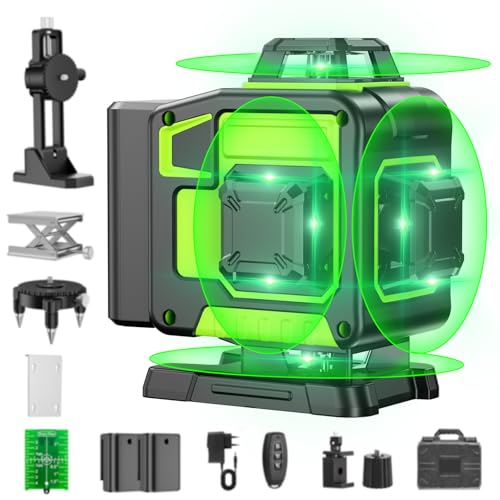
Note: ZyQiu’s model provides 16 lines and 4D cross-line coverage, including dual horizontal and vertical lines that help visualize room geometry for tiling tasks. It delivers similar accuracy and range characteristics as other 360° laser levels, with rechargeable power options and manual mode to project lines at various angles. The included batteries enable a practical workflow for long installations, while the brightness control allows adaptation to different lighting conditions found in kitchens, bathrooms, and living areas. This option is suitable for those who prioritize broad room coverage and versatile angle projection for complex tiling patterns.
CIGMAN Laser Level With Tripod

The CIGMAN model ships with a 36.6-inch tripod, enabling precise height adjustments for floor tiling and wall tiling work. It projects up to 100 feet with a cross-line, green laser beam, delivering ±0.3 mm per meter for accurate alignment. The setup supports indoor and outdoor use, including extended layout runs. The battery life supports up to 28 hours in power-saving mode, with four brightness levels to optimize visibility on different tile finishes. The kit’s tripod and mounting options facilitate stable tiling lines when working on uneven subfloors or elevated surfaces.
Buying Guide: Key Purchase Considerations For Tiling
When choosing a laser level for tiling, consider the following factors to ensure you get the best balance of accuracy, ease of use, and durability.
- Laser Type and Color: Green lasers tend to be more visible in bright rooms and outdoors than red beams. For tiling large areas, look for a device offering multiple 360° planes (horizontal and vertical) to project complete room grids.
- Self-Leveling Range and Accuracy: A self-leveling range of at least ±1/8 inch at 33 feet is common for tiling, with higher accuracy preferred for precise grout lines and complex layouts. Check if there is a manual mode for angles beyond the self-leveling range.
- Power and Runtime: Battery capacity matters on longer tiling jobs. Models with 5200–6600 mAh batteries or dual battery setups can extend work time without interruption. Look for Type-C or USB-C charging for convenient recharges on-site.
- Brightness and Beam Control: Adjustable brightness helps adapt to different tile finishes and room lighting. Ensure the device can maintain visibility on high-gloss or patterned tiles.
- Mounting Options: A magnetic stand, wall plates, or a sturdy tripod can simplify setup on varied surfaces. A tripod with a 1/4″-20 thread is standard for compatibility with most laser levels.
- Durability: For construction and tiling environments, IP rating (e.g., IP54) and rugged housings improve resilience against dust and splashes.
- Warranty and Service: A strong warranty and accessible technical support reduce risk if the tool encounters calibration drift or component failure.
- Included Accessories: Carrying case, extra batteries, and a rotating or tilt-capable stand can significantly improve on-site efficiency.
In sum, for tiling, prioritize models offering multiple 360° lines, bright green beams, reliable self-leveling, and flexible power options. The ability to project floor, wall, and ceiling lines simultaneously can dramatically cut layout time and improve tile alignment accuracy. Compare the options above to identify which combination of lines, battery life, and mounting versatility best matches your typical tiling projects, whether you’re installing kitchen backsplashes, bathroom walls, or large-format floor tiles.