Choosing the right MIG welding wire is essential for strong, reliable sheet metal welds. This guide highlights five top options that balance low splatter, good deposition, and compatibility with common shielding gases. Whether you’re welding outdoor in wind, tackling thin gauge metal, or working with aluminum, these wires cover a range of metals and applications.
| Product | Brand | Diameter | Material |
|---|---|---|---|
| YESWELDER Flux Core Gasless MIG Wire E71T-GS | YESWELDER | .030 in | Mild Carbon Steel |
| YESWELDER ER70S-6 MIG Wire | YESWELDER | .023 in | Mild Steel |
| ARCCAPTAIN ER70S-6 MIG Wire | ARCCAPTAIN | .030 in | Mild Steel |
| PGN Solid MIG Wire ER70S-6 | PGN Bearings | .023 in | Mild Steel |
| ARCCAPTAIN ER5356 Aluminum MIG Wire | ARCCAPTAIN | .035 in | Aluminum |
YESWELDER Flux Core Gasless MIG Wire E71T-GS

This flux-cored, self-shielded wire is designed for outdoor use and does not require shielding gas. It delivers stable arc performance with good feedability and deoxidizers to reduce impurities when welding through light rust or mill scale. The E71T-GS is well-suited for all-position welding on mild steel sheets, offering easy slag removal and low spatter for a clean bead appearance.
YESWELDER ER70S-6 MIG Wire .023

ER70S-6 is a widely used solid MIG wire ideal for sheet metal welding with shielding gas. It offers a high silica and manganese deoxidizer content, which supports smoother beads and reduced post-weld cleanup. Best paired with CO2 or mixed gas (e.g., 80% Ar / 20% CO2) for strong, clean welds on mild steel with good deposition and manageable splatter levels.
ARCCAPTAIN ER70S-6 MIG Wire .030

This 0.030″ ER70S-6 wire delivers stable feeding and strong penetration with good deoxidizers, supporting smooth, visually appealing beads on thin to mid-thickness sheet metal. Suitable for use with standard shielding gas mixes, it balances deposition with manageable heat input for consistent results across projects.
PGN Solid MIG Wire ER70S-6 .023

PGN’s ER70S-6 solid MIG wire emphasizes low splatter and strong deoxidization with silicon and manganese agents. It’s a versatile choice for all-position welding on mild steel, including sheet metal applications like automotive body work or repair patches, where clean beads and minimal post-weld cleanup are valued.
ARCCAPTAIN ER5356 Aluminum MIG Wire .035
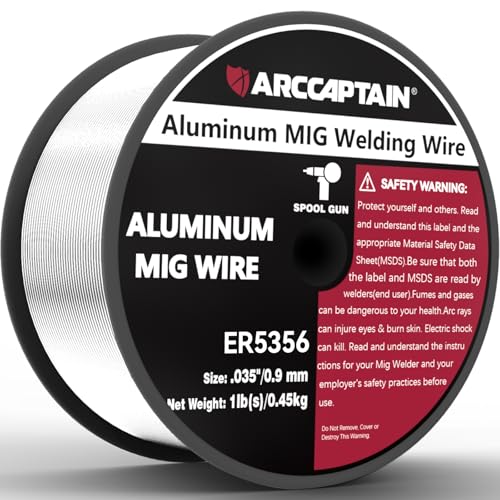
ER5356 is a commonly chosen aluminum MIG wire with good corrosion resistance and weld bead quality for 5xxx-series aluminum alloys. The 0.035″ diameter supports stable welding of thicker aluminum sheet metal, providing reliable deposition and smooth bead formation for structural or fabrication work where aluminum is required.
YESWELDER Flux Core Gasless MIG Wire (5 Pack) E71T-GS

This multi-pack offers the same self-shielding E71T-GS flux-core wire in larger quantities. It is designed for reliable arc stability and easy feeding, with deoxidizers that help produce cleaner welds on mild steel, including sheet metal work exposed to outdoor conditions. It’s suitable for single or multi-pass welds in a portable, gasless format.
Buying Guide
Key purchase considerations for MIG welding wire on sheet metal include diameter, alloy, and shielding gas compatibility. For thin sheet metal, smaller diameters like 0.023″ or 0.030″ help control heat input and minimize burn-through, while 0.035″ is better for thicker or structural work. Mild steel wires (ER70S-6) deliver strong, dependable beads with good deposition, especially when paired with 100% CO2 or Ar-CO2 gas blends. For outdoor or windy conditions, flux-cored wires (E71T-GS) remove the need for shielding gas, though they can produce more spatter than solid wires. Aluminum needs its own set of considerations; ER5356 excels for 5xxx alloys with good corrosion resistance but requires appropriate shielding gas and gun settings. Look for deoxidizers (silicon, manganese) to minimize porosity and improve bead quality. If you’re unsure which diameter to choose, start with 0.030″ to 0.035″ for general sheet metal welding, and adjust based on material thickness and base metal type.
Performance perspectives vary by metal and application. Flux-core wires are ideal for field work without gas, providing portability and wind resistance, but they may require more slag management. Solid wires deliver defined beads and lower spatter under appropriate shielding gas, offering cleaner welds with easier post-weld cleanup. Aluminum wires demand careful control of gas type and flow, plus compatible equipment. Always verify your welder’s compatibility with the wire type, diameter, and shielding gas, and follow manufacturer recommendations for feed rate, voltage, and wire speed to achieve optimal results.