Wood moisture meters help identify dampness in lumber, drywall, and other building materials, enabling timely remediation and preventing warped boards, mold growth, and structural issues. This guide spotlights five reliable options designed for homeowners, woodworkers, and inspectors. Each pick balances ease of use with reliable readings, from pin-type models that measure with metal probes to pinless meters that scan the surface. Use these tools to assess firewood readiness, detect hidden leaks, and compare moisture levels across materials before cutting, installing, or finishing surfaces.
Summary of chosen products
| Product | Brand | Key Benefit |
|---|---|---|
| General Tools MMD4E Digital Moisture Meter | General Tools | Audible/visual alerts with backlit display |
| Klein Tools ET140 Pinless Meter | KLEIN TOOLS | Non-destructive, detects up to 3/4 inch |
| Povlen Pinless Wood Moisture Meter | Povlen | Fast, non-invasive readings with clear indicators |
| RDINSCOS Wood Moisture Meter | RDINSCOS | Four measurement modes and hold function |
| TOPTES TS-630 Wood Moisture Meter | TOPTES | Tri-color backlight and multiple calibration scales |
General Tools MMD4E Digital Moisture Meter
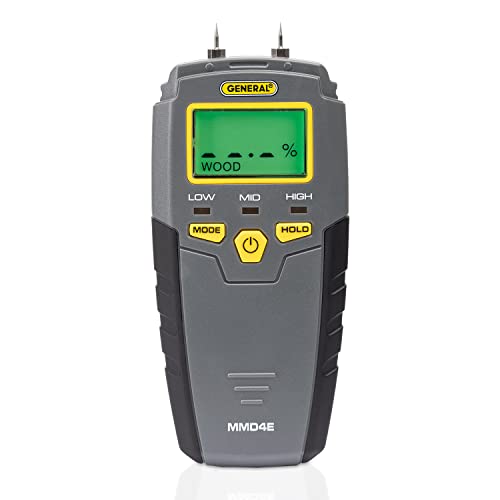
The General Tools MMD4E is a pin-type moisture meter designed to assess moisture in wood and drywall with a backlit LCD and audible/visual alerts. It includes extra 8mm stainless steel pins and a protective cap that doubles as a calibration checker. Reading results appear with high, medium, and low moisture indicators to guide remediation decisions and mold risk assessment. The HOLD feature lets technicians freeze readings for documentation. This model is suited for quick, point-in-time checks around suspicious stains or damp walls.
Klein Tools ET140 Pinless Moisture Meter

The Klein Tools ET140 provides non-destructive moisture detection suitable for drywall, wood, and masonry. This pinless meter uses electromagnetic field technology to measure relative moisture content up to 3/4 inch below the surface, making it ideal for quick scans without damaging pristine finishes. It complements traditional pin-type meters for screening large areas or sensitive surfaces where pin holes are undesirable. It’s especially useful in renovation projects and leak investigations where surface integrity matters.
Povlen Pinless Wood Moisture Meter

Povlen’s Pinless Wood Moisture Meter blends accuracy with user-friendly alerts. It uses high-frequency sensing to deliver fast readings, while a large LCD with an analog bar and audible alerts signals low, medium, or high moisture levels. The device emphasizes non-destructive testing and is capable of handling wood types by adjusting density settings. It also offers a HOLD function for saving results during fieldwork, making it practical for contractors and hobbyists alike.
RDINSCOS Wood Moisture Meter For Wood

RDINSCOS offers a versatile wood moisture meter with four measurement modes and a hold function. It measures moisture content with a relative scale and supports a variety of wood types. The device is designed for both professionals in carpentry and DIY enthusiasts, aiding decisions about suitable firewood, lumber use, and moisture management in walls and floors. The dual-mode capability helps users distinguish between wood and building materials, enabling more precise remediation planning.
TOPTES TS-630 Wood Moisture Meter

TOPTES TS-630 is a handheld moisture meter featuring a 2.25-inch LCD display and a tri-color backlight that clearly signals moisture status. It includes seven calibration scales and two material modes, making it adaptable for firewood, drywall, and other building materials. The device provides data hold and max/min memory, facilitating documentation during fieldwork and ensuring consistent moisture tracking across measurements and sessions.
Buying Guide: Key Purchase Considerations And Comparisons
- Measurement type: Pin-type meters insert probes to measure depth, which can be more accurate for wood but leaves small holes. Pinless meters scan the surface and are non-destructive, ideal for finished surfaces but sometimes less precise for deep moisture.
- Depth and range: Pin-type meters may measure at shallow depths; pinless models vary in scanning depth. Consider your typical materials (lumber, drywall, masonry) and the required depth of detection.
- Calibration and scales: Look for multiple calibration scales or material modes to match wood species and building materials. This improves accuracy across projects from hardwoods to drywall.
- Alerts and display: Backlit LCDs and visual/audible alerts help readings in dim spaces. HOLD functions are useful for recording values while inspecting.
- Durability and accessories: Protective caps, extra pins, and robust housings extend life in workshop or construction-site environments.
- Brand reliability and support: Established brands often offer better customer support and replacement parts, which is helpful for ongoing projects.
- Ease of use and portability: Pocket-sized pens are convenient for on-the-go checks, while larger meters may provide more data but be less portable.
- Use-case alignment: For mold risk or leak detection, prioritize meters with clear low/medium/high indicators and fast stabilization to guide remediation urgency.
When choosing, align the meter with your typical tasks: quick scans of exposed lumber, screening drywall, evaluating firewood readiness, or detailed moisture mapping in renovations. If you regularly test delicate finishes, a pinless meter minimizes surface damage. For precise wood-type readings, models offering multiple calibration scales and material modes improve accuracy. Finally, consider whether you need data logging, hold functions, and audible alerts to streamline field workflows.